No More Drama
As I’m posting this, I have Fergie from the Black Eyed Peas playing in my head: No more drama. You. Don’t want no drama.
From a young age, I could sniff out drama. My instinct was to smooth it over, walk around it or quietly hope it would resolve itself without requiring me to participate. Somewhere along the way, though, drama became an area of study for me. I became curious: How do we resolve conflict? How do we build trust and create bridges across difference?
Maybe you can relate. You may not be dealing with dramatic family arguments or workplace blowups. The drama in your life might look quieter: stepping in because you don’t trust something will get done, carrying responsibility that belongs to someone else, feeling resentful that you’re always the one holding everything together, or avoiding a conversation because you’re not sure where it will lead.
The truth is, drama doesn’t always look dramatic.Sometimes it looks like over-functioning. Sometimes it looks like micromanaging, blame, withdrawal, or the belief that if we don’t handle something ourselves, everything will fall apart.
I was first introduced to the Drama Triangle through training with the Compassionate Listening Project to build trust across difference and use conflict to deepen connection. More recently, this framework came back into my field through work with an organizational client and Brené Brown’s book, Solid Ground.
The Drama Triangle, originally developed by psychiatrist Stephen Karpman, names three common roles we can move through when fear, stress, or threat is activated:
Victim: feeling powerless, overwhelmed, or stuck
Rescuer: over-functioning, fixing, or taking responsibility for others
Persecutor: blaming, controlling, or criticizing
These are not fixed personality traits or permanent identities. They are patterns we can fall into, particularly when we’re stressed, depleted, afraid, or trying to protect something that matters to us. The roles are also not static. We can move between them quickly, sometimes within the same conversation. These are often automatic reactions deployed by fear.
Fear doesn’t always show up as panic. Sometimes it looks like urgency, over-responsibility, irritation, perfectionism, or the belief that if we don’t handle something ourselves, everything will fall apart. We may tell ourselves we’re simply being responsible, protecting quality, or making sure people are cared for. And sometimes those things are true. But when fear is driving the bus, our efforts to help, protect, or solve a problem can unintentionally keep everyone involved stuck in reactive patterns.
This model layers beautifully with the work I teach through Positive Intelligence. When we’re below the line, our fear-based, protective responses are more likely to take over without our awareness. These reactions make sense. They are fast, familiar, and often effective in the short term. We fix the problem, avoid the uncomfortable conversation, take over the project, or make sure nothing falls through the cracks. We may even get immediate relief.
The longer-term cost, however, is significant. We may undermine trust, reduce agency, exhaust ourselves, or repeat patterns that keep relationships and teams stuck. We rotate through roles, react to one another, and spend so much energy managing the immediate problem that we rarely address what matters.
Let’s bring this to life.
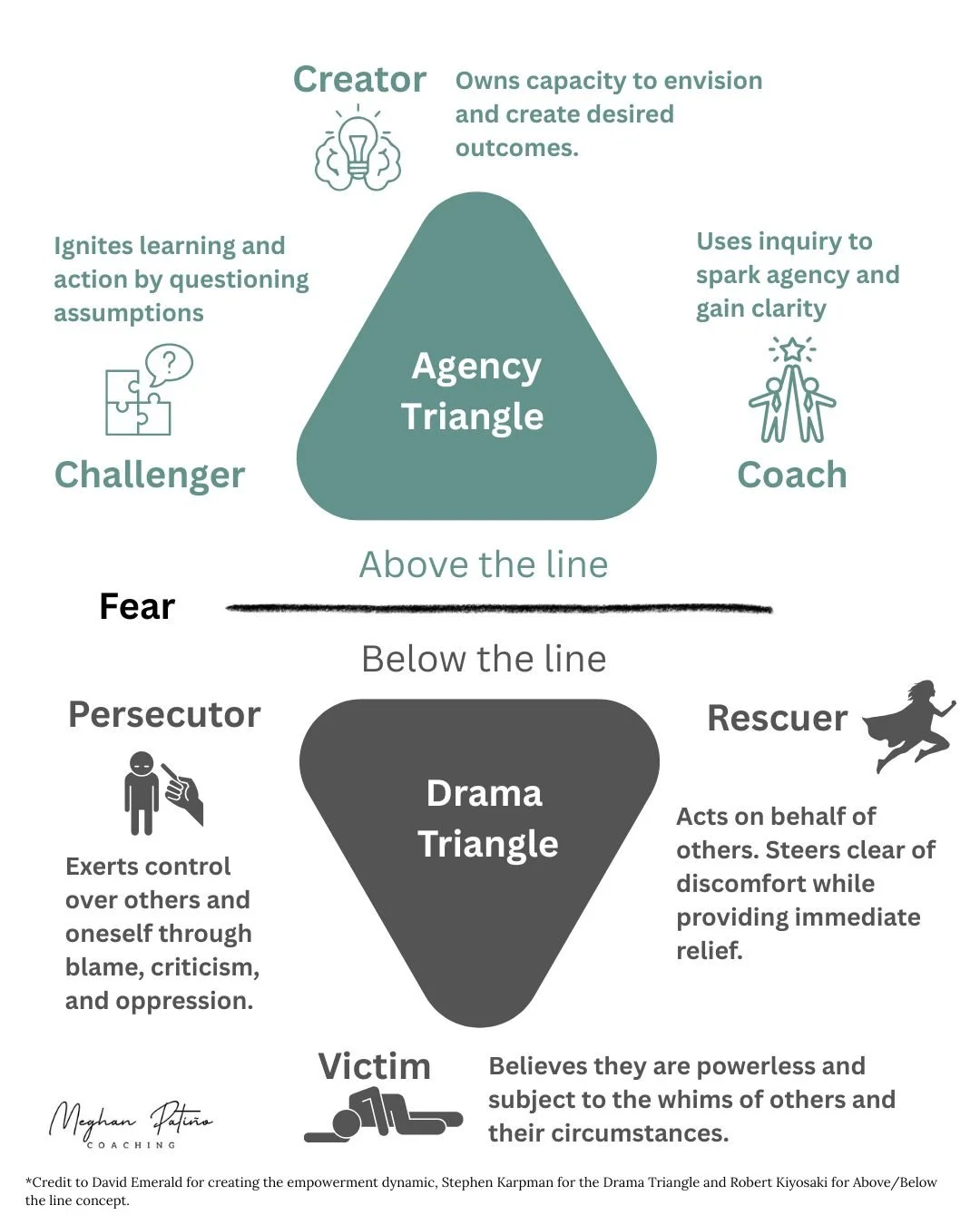
The Drama Triangle shows how fear-based patterns can pull us into Victim, Rescuer, and Persecutor roles. The Agency Triangle offers a different path: shifting toward Creator, Coach, and Challenger.
A Real-Life Example (Because Leadership Doesn’t Stop at Work)
Here’s a moment from my family life. The dishes need to be done. It’s our youngest son’s chore, but he’s out at baseball practice. We ask our oldest son to step in and help. He reacts immediately, criticizing us for “always letting his brother off the hook.” His internal legal defense team shows up, presenting a ten-minute case before begrudgingly doing the dishes. Later, the younger brother comes home tired from practice. The older brother starts teasing him. The younger brother asks him to stop, but the teasing continues. Now we parents step in to protect the younger one. And just like that, the triangle is complete. Our oldest son, who initially felt victimized by having to do extra work, moves into the Persecutor role. We parents, attempting to Rescue, begin criticizing and controlling. Our youngest son lands in the Victim role. Round and round it goes.
Sound familiar?
Most of us have automatic patterns that allow fear-based reactions to drive the bus—at home, and at work. The Drama Triangle isn’t about figuring out who is right, who is wrong, or who is “the problem.” It’s a way to notice the patterns we fall into, the fears underneath them, and the ways we may be unintentionally keeping one another stuck from resolving a conflict.
What Could Happen Instead?
The image above offers an alternative: the Agency Triangle. Rather than rescuing, we can move toward Coaching. Rather than persecuting, we can move toward Challenging. Rather than remaining stuck in victimhood, we can move toward Creating. This doesn’t mean ignoring real power differences, systemic barriers, or circumstances we cannot control. It also doesn’t mean that people who are struggling simply need to “take responsibility” or think more positively. Ushering in agency is the practice of getting curious about where we do have influence, choice, or room to respond differently.
Ok so revisiting our family chore drama…
Our youngest is at baseball practice, and the dishes still need to be done. Instead of barking at our oldest son to take care of them—which he experiences as, quote, “being oppressed”—we pause. We name the facts and invite showing up with a little more team-think. “The dishes are your brother’s responsibility. He’s at practice, and they still need to get done. We need some flexibility today. What feels workable here?” We might talk together about how to help one another when schedules get complicated without creating a system where one person always gets stuck. In this moment, Rescuing and Persecuting shift toward Coaching. We’re not taking over or forcing a solution. We’re asking questions, creating space for input, and inviting everyone to participate in solving the problem. Our oldest son, rather than moving immediately the victim and then taking it out on his brother as the persecutor names his concern: “Sometimes I have late practices too. I don’t want dishes waiting for me just because my brother gets to say, ‘It’s not my job.’” He is willing to talk with his brother about creating a give-and-take system. Here, Persecuting shifts toward Challenging. He is still being honest. He is still naming what feels unfair. But rather than attacking or blaming, he is expressing a concern and helping move the conversation forward. Our youngest son, rather than retreating into complaint or expecting others to handle the problem, shares that he wants to end long practice days with more ease. He is open to flexibility, too, and willing to help create a system that works for both of them. Here, Victimhood shifts toward Creating.
Is this a bit of a Brady Bunch version of family dynamics? Absolutely.
In real life, we don’t always have the capacity, energy, or emotional regulation to slow down and address the underlying pattern. Sometimes everyone is hungry. Sometimes the dishes are the least of anyone’s problems. Above-the-line response doesn’t require perfection. Sometimes it sounds like: “I’m really agitated right now, and I don’t want to take this out on you. This isn’t working for me. Can we come back to it later?” The dishes don’t get done when I want them done. But I’m also not setting off the Drama Triangle.
That, too, is leading above the line.
When the Drama Triangle Shows Up at Work
I see burnout, depletion, and compassion fatigue often in my coaching work with leaders, especially those working in mission-driven organizations. Their strain rarely comes from one place alone. It is layered: dysfunction on teams, pressure at the organizational level, the mental load carried at home, and the toll of navigating systems that weren’t designed with their identities or lived experiences in mind. Many of these leaders fill in gaps because they care deeply about the people they serve. They know what can happen when someone drops the ball, and the consequences can feel too important to ignore. They often have strong empathy skills. They notice what people need, anticipate problems, and step in before things fall apart.These are strengths. But when this strength is overused, unsupported, or disconnected from healthy boundaries, it can pull leaders toward the Rescuer role.
I’ll just do it.”
“It will take longer to explain than to handle it myself.”
“I can’t let this fail.”
“If I don’t step in, people will be hurt.”
Over time, the leader becomes exhausted. Their team may become dependent, hesitant to take ownership, or unsure of their own judgment. The person trying to protect everyone can begin to feel trapped, resentful, or alone. The triangle starts spinning again.
From Rescuing to Coaching
One client I worked with led a newer leadership team. When their work didn’t meet her standards, she often stepped in to refine it or completed parts of it herself. Her fear made sense. She worried that unfinished or lower-quality work would reflect poorly on the organization’s reputation in the community. She cared deeply about the organization, the people it served, and the quality of its work. But by repeatedly taking over, she was carrying more and more responsibility while her team had fewer opportunities to build confidence, judgment, and ownership. Together, we began exploring a different question:
How do I want to form my team and build their skills?
That question shifted the focus from, “How do I make sure this gets done correctly?” to, “What leadership capacity am I helping create?” Instead of immediately fixing or refining the work, she began practicing curiosity. She asked questions such as, “What are you noticing?” “What do you think is working here?” “What support do you need?” and “What would you change before sharing this more broadly?” This took more energy at first. Coaching can feel slower than taking over, especially when you’re already stretched thin and the stakes feel high. But over time, her team began taking greater ownership. They had more room to learn, make decisions, and develop their leadership skills. She felt less like she was constantly micromanaging or waiting for the next mistake. She felt lighter. She also felt more hopeful about the possibility of carrying responsibility without burning the candle at both ends.
That is the shift from Rescuing to Coaching. It doesn’t mean stepping away, lowering expectations, or abandoning accountability. It means building the capacity for other people to lead.
A Small Practice for When Fear Takes the Wheel
When you notice yourself feeling reactive, overwhelmed, resentful, or compelled to take over, pause and ask:
What role am I moving into right now?
Am I feeling powerless or stuck? Am I rescuing, fixing, or carrying more than is mine? Am I blaming, criticizing, controlling, or trying to force a solution?
Then, ask:
What is one small above-the-line response available to me?
Perhaps you can ask a question instead of taking over. You might name a concern without blaming, ask for support, acknowledge what is outside your control while identifying where you still have influence, or simply pause before responding. The goal isn’t to eliminate fear or become perfectly calm, patient, and emotionally evolved every time someone leaves dishes in the sink. The goal is to notice our automatic patterns sooner, understand what they may be trying to protect, and expand our ability to choose a response that creates more agency, capacity, and connection. Because when fear takes the wheel, we often repeat the patterns we know. When we build awareness, we create more room to choose.
Want Support Shifting the Pattern?
If you’re a leader who is carrying too much, over-functioning for your team, or feeling caught between responsibility and burnout, you don’t have to figure out the pattern alone.
Through my Positive Intelligence for Leadership course and individual coaching, I help leaders build awareness of the automatic habits that pull them into stress and reactivity. Together, we develop practical tools for responding with greater clarity, agency, and intention.
Sometimes the first step isn’t doing more. It’s noticing the pattern you’re already in—and discovering that there may be more choice available than fear would have you believe.