Leading with Paradox: The Power of the Both/And
I've been listening to Esther Perel's Mating in Captivity with my partner. The book explores a tension many of us experience in relationships: the seemingly opposing forces of love and desire. Love seeks security, familiarity, and comfort. Desire craves novelty, mystery, and freedom. Both are essential, and yet they often seem to pull us in opposite directions.
My ears perked up when Esther referenced a leadership framework designed to help organizations thrive by navigating paradox. The framework, developed by Barry Johnson, is called Polarity Management. At its core is a simple but profound idea: some challenges are not problems to solve, but tensions to manage. The goal isn't to choose one side and eliminate the other. The goal is to learn how to move between them.
The Paradox I Know Well
One of the paradoxes that emerged in a client conversation also named a tension I often wrestle with myself. The tension between collective well-being and personal interest.Coming from social work, activism, motherhood, and partnership, I've been deeply conditioned to value contribution, service, and caring for others. A core memory from age nine is being called into a serious meeting with my jump rope coaches and my parents (yes, I was on a world championship jump rope team) and being told that I was playing too much at practice and needed to be helping coach the younger teammates.
This team was my second family and a source of deep belonging. At that young age, I absorbed the message that playing and enjoying myself was dangerous territory. It could make me selfish. Self-absorbed. Less committed. Less good. Looking back on that moment, I doubt the boys I was playing with at practice got the same reprimand.
That voice still shows up.
Recently, while on a trip to Whidbey Island, my Inner Judge decided that the middle of the night was the perfect time for a performance review. I woke up to a stream of thoughts insisting that if I kept enjoying my life this much, I was somehow going to become an irrelevant coach. Apparently joy is a professional liability.
I caught it and held it lightly, but this is a familiar tension. Part of me still unconsciously associates contribution with sacrifice. Yet another part of me has been gathering evidence that adventure, creativity, pleasure, and rest don't compete with service. They sustain it. In fact, some of the people I most admire contribute enormously to the collective good not because they deny themselves, but because they have followed what they love. A friend of mine builds community through dance. José Andrés, a renowned chef, has transformed food relief efforts to reinvigorate local networks that strengthens the local economy through World Central Kitchen. Their contribution doesn't emerge from drab duty. It emerges from aliveness. The challenge is learning how to hold both.
What Happens When We Overidentify With One Value
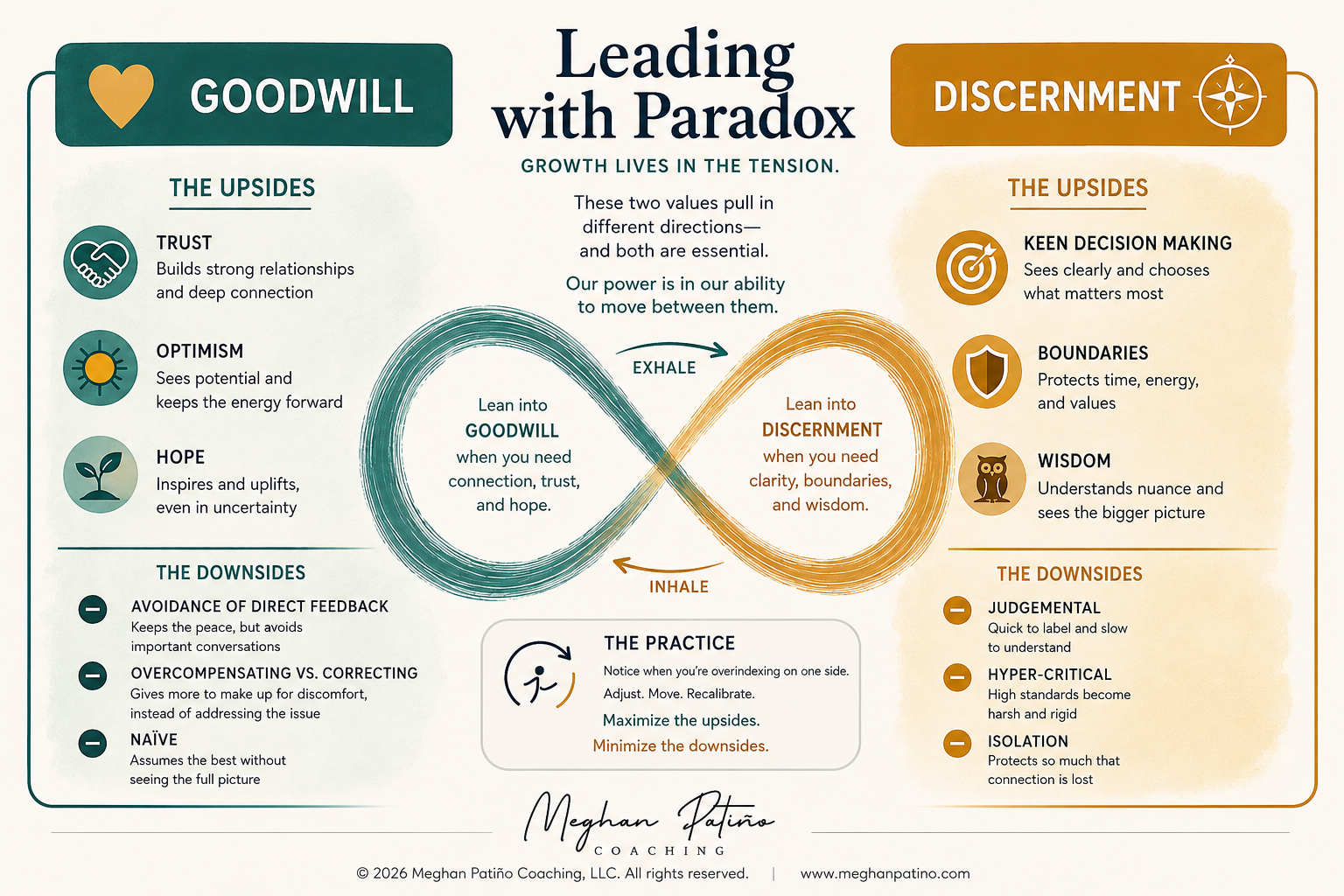
Barry Johnson often uses breathing as a metaphor for paradox. To stay alive, we inhale. To stay alive, we also exhale. If we become attached to only one half of the process, things go poorly rather quickly.
Leadership works much the same way. Organizations need stability and innovation. Connection and accountability. Individual responsibility and collective care. Goodwill and discernment. The challenge isn't choosing one side. It's learning when to lean toward one and when to move toward the other. Working with another client, a business owner who found herself overwhelmed after a series of hires created more work, more stress, and more direct involvement than she'd intended. As we explored her leadership style, a pattern emerged. She led almost entirely through goodwill. She gave chances, extended trust, and assumed positive intent. These are beautiful qualities. But strengths become liabilities when they lose their counterpart. Without discernment, goodwill became overcompensation, poor boundaries, avoidance of difficult conversations, and repeated disappointment. What she came to realize was that discernment wasn't cold, punitive, or cynical. Discernment was what allowed goodwill to thrive without consuming her.
As I listened to her describe this realization, I couldn't help but recognize my own version of the pattern. My instinct is often to lean toward collective well-being because that feels like a safer bet to my fear brain. When overused, that value can morph into overlooking my own capacity, simmering resentment, or (so cringy) saviorism. It can convince me that service should always come before my own needs. It can quietly disconnect me from the very vitality that allows me to show up well in the first place.
The irony is that practicing healthy self-interest has made me more effective, not less. It has led to more adventure, more joy, a stronger marriage, and honestly, more energy for the work I care about. This is why I find paradox so compelling. Often the value we judge most harshly carries medicine for us. The invitation is not to abandon our values. It's to become curious about the values we reject. What if the thing that's driving us crazy contains something we need?
Why Leading With Paradox Is So Hard
Of course, this is easier said than done. Our brains are wired for black-and-white thinking. It's efficient to categorize. Good or bad. Right or wrong. Safe or unsafe. That kind of thinking serves an important purpose. It helps us move through daily life without exhausting ourselves with endless decisions. But living meaningful lives, leading people, and navigating complex organizational challenges rarely fit neatly into those categories. Leading with paradox requires something different. It asks us to tolerate tension, uncertainty, and nuance. It asks us to resist the urge to collapse complexity into certainty. It asks us to hold two seemingly opposing truths long enough for a new possibility to emerge.
The encouraging news is that this capacity can be strengthened. Research on neuroplasticity continues to show that our brains change through deliberate practice and repetition. Just as we can build physical strength through repetition, we can build the mental fitness required to notice either/or thinking and move toward both/and. That's one of the reasons I often receive emails from former clients months after our work together has ended. They're often written with a mixture of excitement and disbelief. A difficult workplace relationship has softened. A new career path has emerged. A business is growing without consuming the owner's life. What changed wasn't that they finally found the perfect answer. More often, they stopped standing rigidly on one side of a paradox and learned how to move between two values that were both necessary. They learned they could dance.
A Few Questions for your Back Pocket
When you're feeling stuck, overwhelmed, or in conflict, consider asking:
What value am I overidentifying with right now?
What are the upsides of this value?
What are the downsides when it's overused?
What opposing value might support this situation?
What story do I tell myself about that value?
What becomes possible if I held both?
Stay Wild,
Meghan
P.S. One of the things we practice inside Positive Intelligence for Leadership is building the mental fitness required to hold complexity without collapsing into black-and-white thinking. If you're navigating tension within yourself, your team, or your organization, it may not be a sign that something is broken. It may be an invitation to strengthen your capacity to lead with paradox. I'd love to support you in that journey. Hit reply or schedule an connection call to get your questions answered!